25/01/2026
WHO issues new mpox situation report as global surveillance tracks cases through end of 2025
The World Health Organization released Situation Report #62 on Jan. 23, updating the global mpox picture through Dec. 31, 2025 and providing Africa-specific updates through Jan. 18, 2026 alongside operational response notes through Jan. 22.
- Published
- Revised
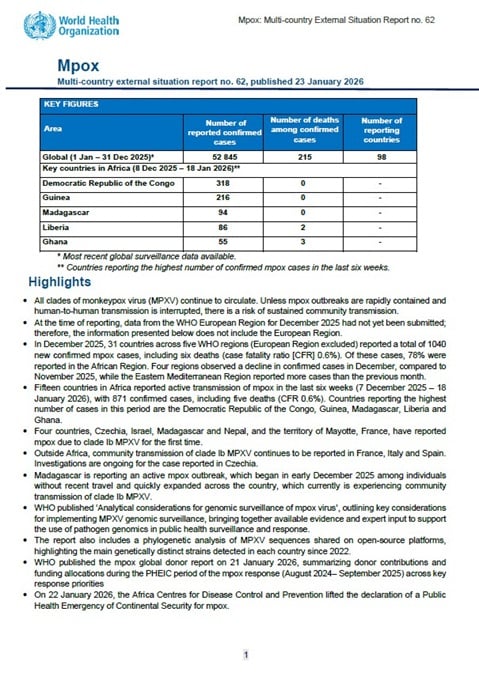
The World Health Organization on Friday, January 23, 2026, published its latest external situation report on the multi-country mpox outbreak, offering a consolidated look at surveillance and response as countries continue to manage transmission and public-health workload. The document—Situation Report #62—updates the global epidemiological picture with data through December 31, 2025 and includes an Africa-focused update through January 18, 2026.
In addition to case-tracking summaries, the WHO report outlines operational response updates through January 22, 2026. Those sections are intended to help governments and partners gauge readiness, identify gaps in detection and care, and monitor whether response actions are keeping pace with changing conditions.
While mpox has shifted from the crisis pace seen earlier in the outbreak, health agencies have repeatedly emphasized that the work has not ended: sustained surveillance remains essential to spot flare-ups, measure the impact of vaccination strategies where deployed, and respond to clusters quickly enough to prevent broader spread.
Public-health experts note that mpox reporting often depends on testing access, clinical awareness, and the strength of contact tracing. As a result, comparative interpretation across regions requires caution, particularly when case definitions, lab capacity, and reporting timeliness differ from one health system to another.
The WHO’s continued publication of situation reports signals that global monitoring remains active. The report’s intent is practical: to provide decision-makers with an up-to-date snapshot of trends and response actions, and to support coordination among international partners as national systems balance mpox with other urgent priorities.
Health authorities generally advise communities to follow local guidance, seek care for symptoms consistent with mpox, and pay attention to targeted vaccination and risk-communication campaigns where relevant. The WHO report serves as a reference point for that evolving guidance by summarizing the latest available consolidated data and response posture.